The Illusion of Movement
Jun 16, 2026
“Never mistake activity for achievement.” - John Wooden
I planned this blog for years.
I bought the domain. I chose the stack, then changed it, then changed it again. I filled a list with sixty article ideas. I built a template, set up a project, read about how other people write. The setup kept getting better. The number of published articles stayed at zero.
Every one of those steps was real work. None of it was progress. I was polishing the setup while the only thing that mattered, shipping an article, never moved. For years.
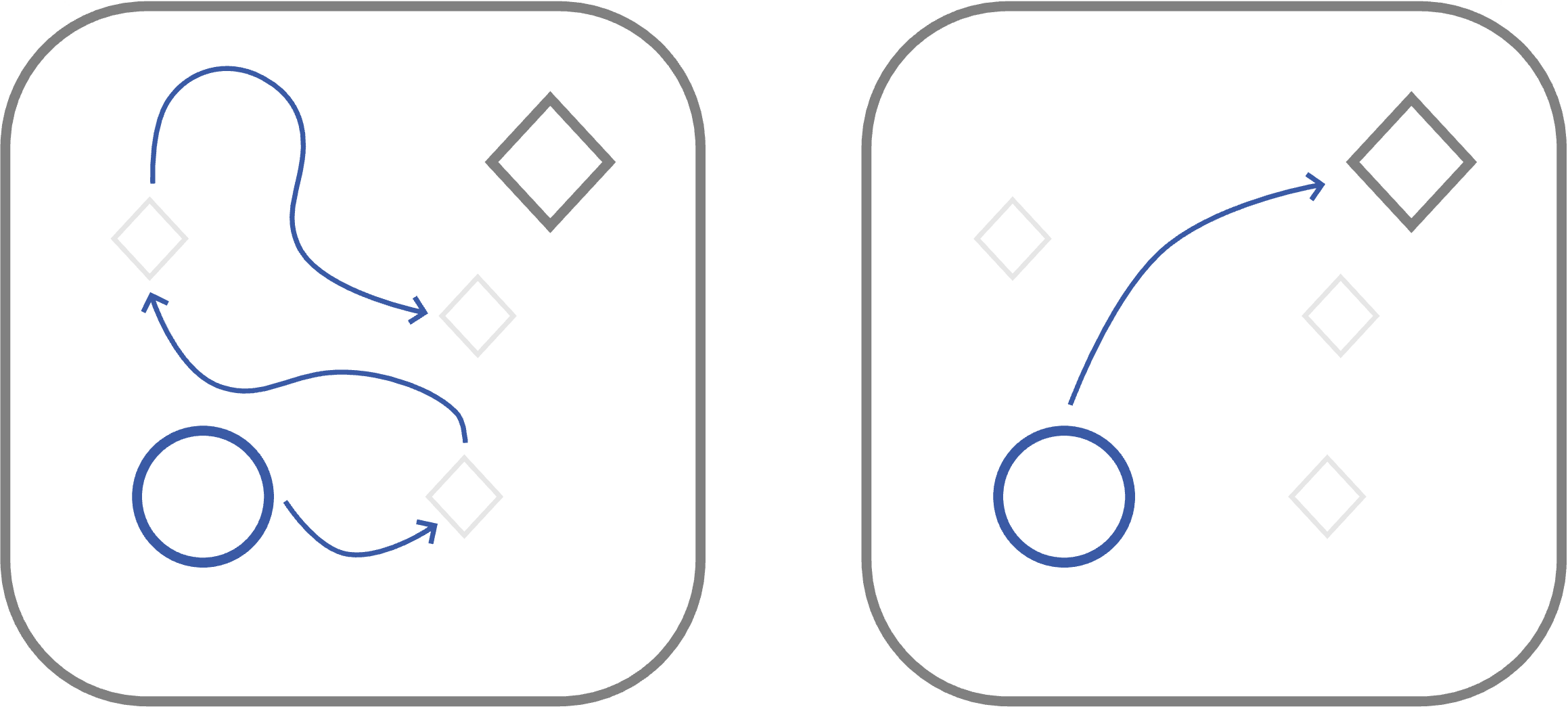
I call this gap the Illusion of Movement: spending real energy on motion that looks like progress, while nothing that mattered moved an inch.
Speed is not velocity
“If you don’t know where you are going, you’ll end up someplace else.” - Yogi Berra
Physics already drew this line for us. Speed is how fast you are moving. Velocity is how fast you are moving in a direction. Speed is a number. Velocity is a number with a direction attached.
You can have a lot of speed and no velocity. You can run flat out and end the day exactly where you started. Most busy work is speed. Only velocity moves the needle.
We have all felt the difference. The inbox we clear and clear that never empties. The todo list where we check ten boxes and the goal is no closer. The tired-without-the-payoff feeling at the end of a full day. Doing more does not get us out. More speed without direction only gets us to nowhere sooner.
And it scales. A team can run hot for a quarter, every ticket moving, every deadline met, and ship nothing a customer can feel. A company can do it for years. The damage grows with the size of the thing that is moving.
Where it hides
The dopamine of busy
“It is not enough to be busy; so are the ants. The question is: what are we busy about?” - Henry David Thoreau
Every checked box gives a small hit. Close an issue, clear a channel. It feels like progress because it registers as something. But busy and productive are not the same word. The tasks that give the cleanest hits are usually the smallest, and the smallest are rarely the ones that matter.
The seductive shortcut
There has always been a fast way to make something that runs, a tool or a shortcut that turns an idea into a working thing in an afternoon. The first time, it feels like magic.
For prototyping, validation, and learning, it is magic. The moment we try to build a business on it, the bill arrives. Code written without an architecture decided upfront is a fast road to scaling problems, brittle features, and, worse, security holes. The speed was real. The direction was missing. We moved quickly toward a place we will have to leave.
Building the wrong thing
“There is nothing so useless as doing efficiently that which should not be done at all.” - Peter Drucker
The most expensive version of this is building the wrong thing well.
We know the shape of it. The refactor that runs for a quarter and leaves the product exactly where it was. The feature shipped on time, to spec, that nobody uses. The dashboard with twelve numbers climbing, none of them the one that actually moves the business. Every hour of it was effort. None of it moved the goal, because the goal was never the thing being measured.
A civil engineer would never start a bridge without knowing if it carries cars, trains, or people. Imagine designing the footbridge, then being told it now has to carry trains. In steel and concrete that is a catastrophe. Software lets us do exactly that, because software is soft. We build first and find the purpose later. We just underestimate the cost. Changing direction after we have built is expensive, slow, and sometimes worse than starting over.
The best systems I have helped build looked slow at the start. The early effort went into understanding the problem before any building began: who it was for, what it really had to do, where it would break. It felt like a stall. That slow start is what gave the building, when it came, its direction.
This is why discovery, understanding the problem and testing the solution before committing to it, is the cheapest insurance we can buy against the most expensive mistake a team can make. The work that feels like a detour is often the only part with velocity.
Getting out
You do not escape the Illusion of Movement by working harder. More effort is more motion, and motion is rarely the problem. You escape it by constraining the motion and pointing it.
Two practices do most of the work.
Limit work in progress. A team caught in the illusion usually has too many things in flight at once, all pushed hard, none finished. Cap the number. Borrow the discipline from Kanban: a hard limit on how much can be in progress at any time. Fewer starts, more finishes. The cap feels restrictive. The restriction is the work. It forces the team to close what is open before opening more. And because every slot is now scarce, starting becomes a deliberate choice instead of a reflex. Both move you forward: finishing what you start, and starting only what matters.
Make one metric visible. Pick the single outcome that defines the period, the one number or capability that, if it moves, means you won. Borrow the idea from SLOs: a clear, measured target you check against constantly. Put it where everyone sees it. Once the goal is visible and singular, motion can no longer pose as progress, because anyone can look up and see whether the goal actually moved.
There is a third reflex underneath both: subtraction. You rarely add your way out of the illusion. More often you remove, you say no, you cut the work that was never pointed anywhere.
When speed is the point
“If you’re not embarrassed by the first version of your product, you’ve launched too late.” - Reid Hoffman
There is a trap on the other side.
Sometimes you find direction only by moving. Early in a project, the path is not knowable from a desk. A startup has a goal and no map to it. Here, motion is the research. You try a street, see where it leads, drop it, try another. Speed first and direction second is exactly right.
The difference is intent. Exploration keeps its experiments short, checks constantly whether they are useful, and stays ready to drop what fails. That is what velocity looks like before it finds its direction. The Illusion of Movement is not motion. It is motion that has stopped asking where it is going.
The model cuts both ways. Pushed too far it becomes its own trap. Every decision studied to death. Every start held back for one more week of certainty. Momentum lost in the name of direction. That is its own illusion. The goal is to aim, and aiming can be quick.
Wrap-up
“How we spend our days is, of course, how we spend our lives.” - Annie Dillard
It is counterintuitive to slow down to move faster. It feels wrong to stop checking boxes, to leave the inbox full, to spend an hour deciding instead of an hour doing.
But speed is cheap and direction is not. We are all busy. What matters is whether we are busy with the right things, or just running, fast, in place.
So before the next sprint of motion, spend the few minutes that feel like a waste. Point the work at the goal, out loud, in one sentence. If you cannot draw the line, you have found the illusion. Invest the time to save the time.